 Impact Report


 Go back to In the News Page
CIC Founder: “One of the great American cities in innovation”
CIC Founder Tim Rowe chats with CIC St. Louis Manager John Land in "Where Innovation Happens" podcast. | August 20, 2026
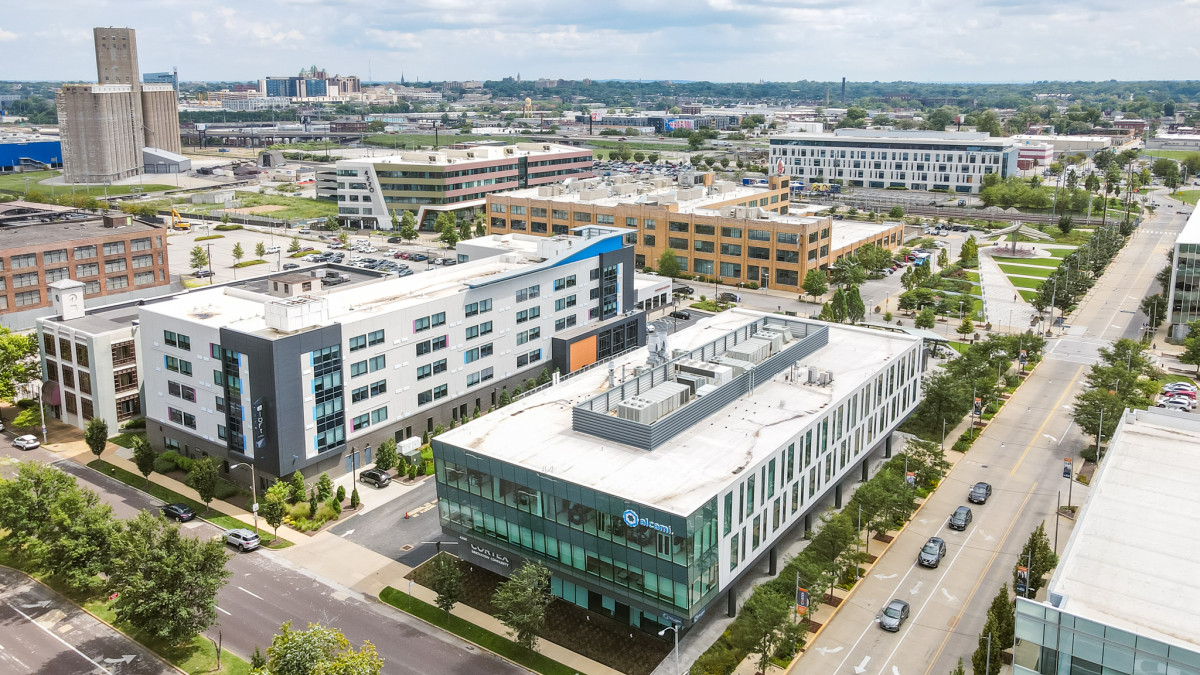
From a manufacturing hub for automobiles and rotary dial telephones, to a hollowed out symbol of urban blight, and back to a 200-acre district that’s become one of the world’s largest centers for innovation. That’s the story Tim Rowe came to hear in a recent edition of his podcast, “Where Innovation Happens.”
“St. Louis is one of the great American cities in innovation," said Rowe, founder and executive chair for the New England-based Cambridge Innovation Center (CIC). “If you could go anywhere, you would choose St. Louis for the people who are here, the expertise, the talent that's here—you'd be crazy not to come here.”
Rowe’s global firm manages 1.5 million square feet of innovation space on three continents. The Cortex Innovation District in St. Louis was CIC's first expansion outside of Cambridge. Rowe's podcast introduces listeners “to some of the extraordinary people building innovation ecosystems around the world.” For episode eight of his video podcast, Rowe interviewed John Land, general manager of CIC’s space at Cortex.
The wide-ranging conversation touched on the industrial history of St. Louis, including some of the innovation and manufacturing that once happened in buildings now managed by Land’s CIC operation. That includes Cortex’s 4240 Duncan Avenue building, formerly a Bell Telephone assembly plant, and 20 S. Sarah Street, once an assembly plant for the Dorris Motorcar Company. CIC also operates an 8-year-old building at 4220 Duncan Avenue.
Rowe also noted the bold decision nearly 25 years ago by five major St. Louis institutions—Washington University, Saint Louis University, the University of Missouri-St. Louis, BJC HealthCare and the Missouri Botanical Garden—to pool resources and expertise, establishing a place of possibility: the Cortex Innovation District.
Land described CIC’s role at Cortex as the “connective tissue” for the District, providing turnkey access to space, internet access and other physical support, as well as more advanced facilities such as wet labs and research bench space. Plus, CIC stages events and gatherings to promote community and idea cross-pollination.
“The idea is that you can come into CIC St. Louis and immediately access that network of not only all the intelligent people building phenomenal things in St. Louis, but all the people who are supporting that work,” Land said.
Rowe marveled with Land at the size and scale of the innovation Cortex convenes on its 200-acre campus—from companies boldly working to vanquish cancer, to biotech firms striving to identify and squash the next pandemic before it happens.
“I can't think of another innovation hub this big really anywhere except on the coasts,” Rowe said, noting that even CIC’s operation in Berlin isn’t as large. “I think this is the largest innovation hub in the center of the United States.”
Throughout the interview, Rowe and Land highlighted Cortex’s deliberate efforts to capitalize on and bolster the region’s growing, global reputation as a hub for innovation in biotech, life sciences and even financial technology. “There's a lot happening in those three areas,” Land said.
Land came to St. Louis 13 years ago “sight unseen,” as he described it, for a job at WashU before moving to a post with CIC at Cortex nearly nine years ago.
“I think like so many people, I just didn’t know what was going on here,” he said. “I really found a hidden gem of a city.”
Related Blog Posts

We Are Cortex | Tepra Wells
Tepra Wells - Founder, Tepra Marketing LLC and Cortex Square One Graduate by Kurt Greenbaum

We Are Cortex | Rodrigo Reis, PhD
Rodrigo Reis, PhD - Professor of Public Health, Bursky School of Public Health, Washington University by Kurt Greenbaum
